AI Use in Education
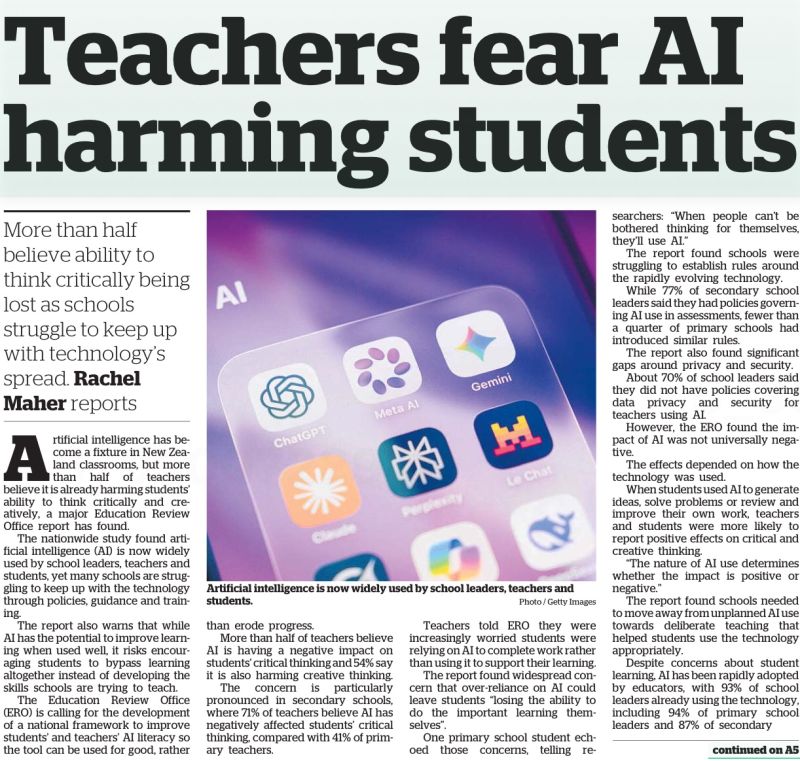
This week’s New Zealand Herald front page headline captures a concern seen regularly in schools, even my own.
So, that concern is valid. If students are using AI to avoid recalling, questioning, explaining and revising, the technology then becomes a substitute for learning. Emerging research suggests that AI may improve the immediate quality or speed of students’ evidence of learning while weakening subsequent learning when it removes productive struggle.
The findings reported in the article suggest that the effects depend strongly on how AI is used. When students use it to generate ideas, solve problems, receive feedback or improve their own learning, teachers are more likely to observe positive effects on critical and creative thinking. This aligns with international guidance on the use of AI. That thoughtfully designed AI use can create opportunities for inquiry, evaluation and creative expression rather than simply producing answers.
In my own classroom, that distinction is clear. AI should be a thinking partner, not a replacement thinker.
Students need to think first, prompt second and judge third. They should be expected to question the response, check its evidence, identify errors, explain what they changed and remain responsible for the final work. The learning must remain visible.
The real risk is not simply that students have access to AI. It is that access has arrived faster than coherent policy, professional learning and explicit AI literacy education. How can we blame students for not using AI correctly when we have not taught them? And that is not just about how to operate the tools. Students (and teachers) must also understand AI’s limitations, evaluate its outputs and make responsible decisions about when and why to use it.
Banning AI will not prepare young people for an AI-shaped world. Uncritical adoption will not prepare them either.
Our task is to design learning in which AI increases curiosity, feedback and agency while preserving the intellectual effort through which knowledge, judgement and creativity are developed.
The question is no longer whether AI belongs in education. It is whether we will teach students to use it deliberately, ethically and intelligently. That requires support.